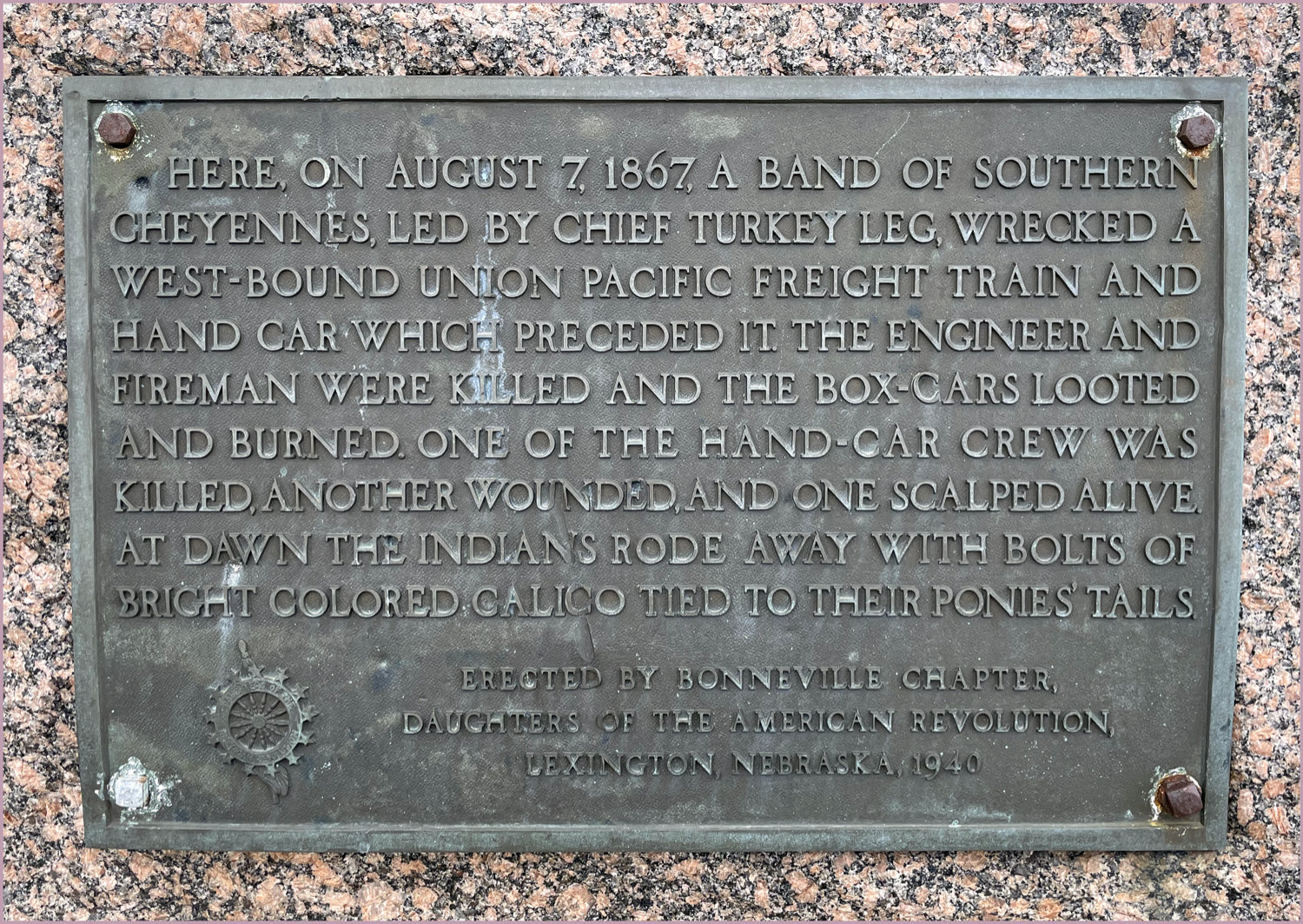


This memorial is about four miles from my childhood home near Lexington, Nebraska, which had been a homestead of Michael Delahunty, a railroad section boss at the time of the raid. Cheyenne Chief Turkey Leg (or Turkey Legs, depending on the source) had fought at the Little Bighorn in defeat of General Custer, and had vowed to “kill an iron horse,” which he did at the site above. His stated incentive: “All tribes (of the plains) needed buffalo for livelihoods, so we tried to stop vehos from bringing in their iron horses and splitting and destroying the buffalo herds. I set out to lead a raid to ‘kill’ an iron horse.” – Crow Agency, MT 1938. (The term “vehos” is a Cheyenne word originally referring to spiders, tricksters, and later to white men.)
For more about the Chief, see: https://davidhumphreysmiller.org/chief-turkey-legs/.
Michael and his brother Patrick, along with others, rode a handcar to the site of the train derailment and Patrick broke up the raid by shooting the “leader” with his long range rifle, which had led me to believe that Chief Turkey Leg had been killed to end the fracas. However, quotes attributed to him after the raid and the painting above, done by David Humphreys Miller years later, prove that he survived. Perhaps he was only wounded, or it was another warrior that had been shot. Either way, he completed his mission to become a hero to his people.
Michael Delahunty’s account of the raid is copied below. (Source: https://usgennet.org/usa/ne/topic/resources/OLLibrary/Journals/HPR/Vol07/nhrv07p5.html)
“THE PLUM CREEK RAILROAD ATTACK – 1867
The Lexington Pioneer prints a very interesting account written by Michael Delahunty who settled at what was then called Plum Creek station on May 5, 1867. His account includes the familiar frontier story of the wrecking of the Union Pacific train by Indians near Lexington, August 7, 1867. As his account contains some personal observation and new material it is printed in part as follows:
On the night of August 7, 1867, occurred the railroad wreck and it took place about 3 1/2 miles west of the present site of Lexington. The wrecking was done by the Indians shortly after dark, about nine o’clock. The section men had been working at that point during the day and had left their tools alongside the track. The Indians being on the lookout and watching them from the islands in the Platte river, took the tools, pulled out the spikes and raised the rails to a height of three or four feet. They then took down the telegraph wires and fastened blocks of wood to each rail. As there was only one wire used for telegraph, the agent discovered at once that he could not send or receive messages and he ordered the section men to go and find the trouble. So brother Jim and six men, Tim Murphy, Pat Handerhand, John Kearn, Thompson, Wallace, and Pat Griswold, went out on the hand car to find the trouble and the first they noticed was a fire built along the north side of the track and the Indians were hiding on the south side in some tall grass. The hand car hit the blocks of wood which the Indians tied to the rails and jumped the track. About this time forty Indians on ponies appeared and started yelling and shooting arrows and guns at the section men, who were armed and who returned the fire. The Indians kept riding in a circle around the men, who realized that they were in a bad fix and when the chance came they made break to get away and in doing so the first man captured was Pat Handerhand. The Indians took their tomahawks and cut him to pieces. The next man they got was Thompson. They scalped him. Pat Griswold got shot in the hip and the other three men made their escape uninjured. About the time they were scalping Thompson a freight train came along and run into the trap. It had about twenty-five cars and the first four or five cars were filled with dry goods and provisions, and when the Indians heard the noise of the wreck, they left Thompson and the others and went to the wreck. The engineer and fireman were killed instantly when the train was wrecked, the conductor was uninjured and he ran back on foot toward Plum Creek and stopped another train which was coming along and backed the same into that station. The next day the two brakemen on the wrecked train showed up at Brady Island. The Indians after plundering the cars and taking all kinds of merchandise set them on fire and held a big Pow-Wow or Indian dance.
The same night the conductor of the train received word from quarters at Omaha, that if it was not safe or their lives in danger for all the men to leave Plum Creek. So he took the men and their families on the train, with the exception of Patrick Delahunty, who stayed with Daniel Freeman and his family, to guard their property, and we went east as far as Elmcreek where we stayed all night in a sod dobie. The next morning we received orders to return to Plum Creek to see how things were. The only two women on this train were my wife and Pat’s wife and children, and we sent them on to Grand Island. When we got back to Plum Creek we could see a black smoke where the wreck was so the conductor hooked a flat car on the front of the engine and we all got aboard with our guns and amunition (sic) and started toward the wreck. About a mile from the wreck we stopped as there were Indians around and we were afraid of being surrounded. After the train stopped we saw the Indians riding around in circles with bolts of calico tied to their horses’ tails and a bunch of them around two barrels of whiskey. Brother Patrick being a crack rifle shot and having a long range rifle, 50-70 calibre, they delegated him to pick off the leader, which he did with the first shot. This caused them to scatter and leave for the islands in the river. We then moved to the wreck and hooked onto the caboose and pulled it away from the burning cars. We found coffee, sugar, dry goods and other provisions scattered about; boots with the tops cut off — the Indians cut the tops off and put them on their legs but wouldn’t wear the bottom part — in fact we picked up about three carloads of merchandise that was left on the ground.”
#railroad #plumcreek #derailment #nebraska
 Eskildoodle Photos and Feelings
Interesting post. Thanks.
LikeLiked by 1 person