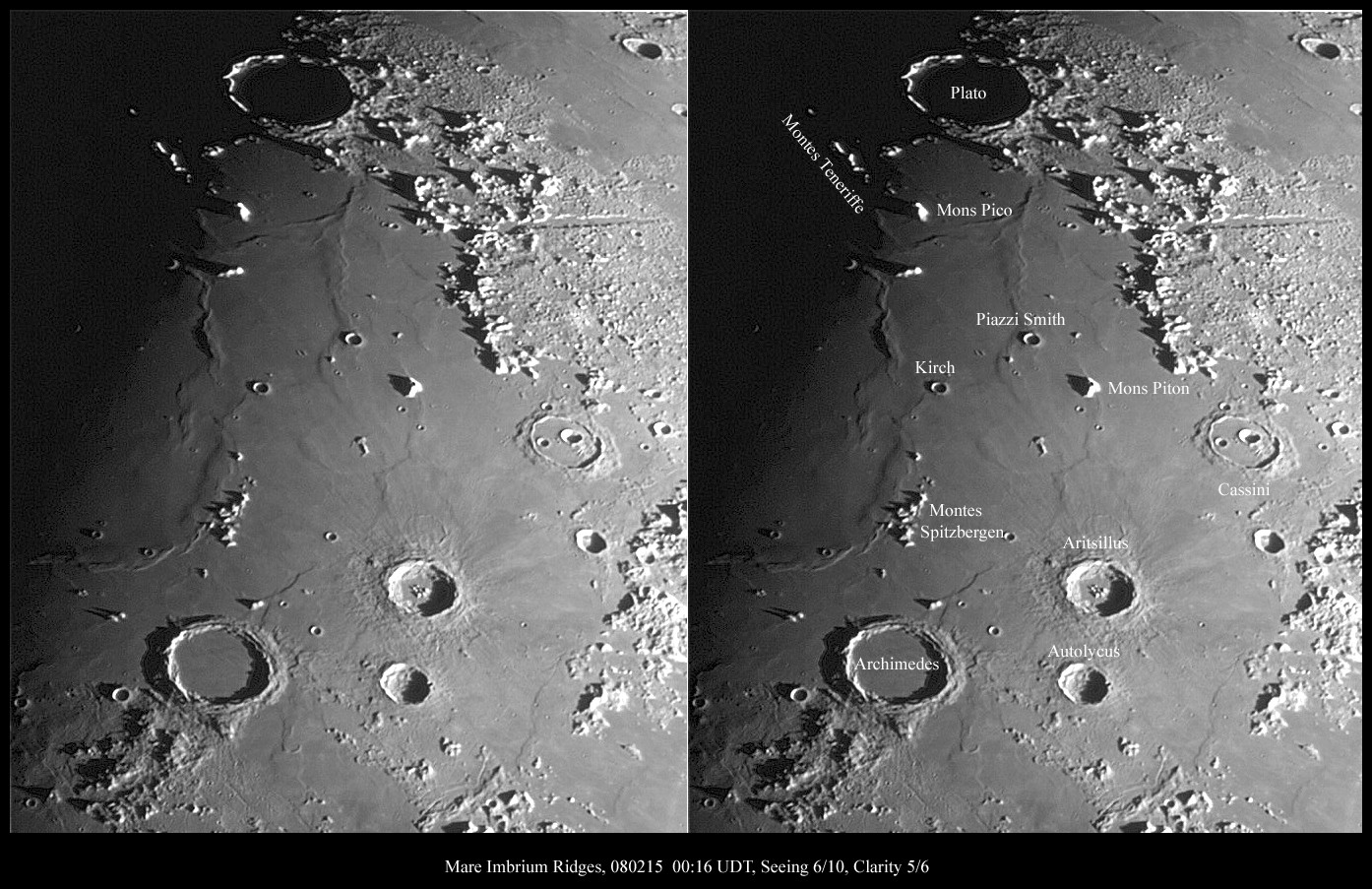
Think of the moon, and craters often comes to mind. However, more than craters mark its appearance. In addition to craters, there are peaks, mountain ridges, valleys, and plains of hardened lava across its surface. In the course of cooling, the lava settled and wrinkled, as seen left of the photo’s center, like thick, chocolate frosting on a warm cake. Some of the craters such as Archimedes also were flooded with lava that has now solidified.
Several peaks rising above the volcanic plains are labeled, and mountains seem to arc along the right side of the photos. Believe it or not, they mark the ring of a huge impact crater known as Mare Imbrium, the “sea of showers.” One mighty gorge, the Alpine Valley, slices straight through those mountains on the upper right.
Three craters on the lower central part of the images boarder a remarkable historical site. In September, 1959, somewhere between Archimedes and Autolychus, Soviet probe Luna 2 became the first spacecraft to ever hit the moon. It was a major feat; I remember as an 8-year old, hearing of it in my one-room country school, and some people were worried about what the Russians might be up to next. It was likened to firing a bullet and “hitting a fly in the eye at a distance of seven miles.” Wow!
In honor of the that accomplishment, the terrain by those craters is now known as Sinus Lunicus. It was a very logical choice, even thought the name sounds a little ludicrous to me.
#moon #sinuslunicus #luna2 #craters #mountains #lava #mareimbrium
 Eskildoodle Photos and Feelings